Notice: 函数 WP_Styles::add 的调用方法不正确。 The style with the handle "storefront-woocommerce-style" was enqueued with dependencies that are not registered: storefront-style. 请查阅调试 WordPress来获取更多信息。 (这个消息是在 6.9.1 版本添加的。) in /wordpress/wp-includes/functions.php on line 6260

KC-4762

293T-ACVR1C-KO Cell Line

Home » 293T-ACVR1C-KO Cell Line

Background of 293T-ACVR1C-KO Cell Line

The Activin A Receptor Type 1C (ACVR1C), also known as ALK-7, belongs to the transforming growth factor-beta (TGF-β) superfamily of serine/threonine kinase receptors. ACVR1C plays a significant role in various biological processes, including cell proliferation, differentiation, and apoptosis by mediating signals from activin A, a cytokine involved in numerous physiological functions. Research has indicated that ACVR1C is implicated in metabolic regulation, immune responses, and embryonic development. Dysregulation or mutations in this gene have been linked to several diseases, such as polycystic ovary syndrome (PCOS) and cancer. Studies on ACVR1C have revealed its potential as a therapeutic target for these conditions due to its influence on intracellular signaling pathways like SMAD-dependent and -independent pathways. Understanding the molecular mechanisms underlying ACVR1C's function could provide new insights into disease pathogenesis and pave the way for innovative treatments.

Specifications

Catalog Number:
KC-4762
Cell Line Name:
293T-ACVR1C-KO Cell Line
Clone Number
Host Cell Line:
293T
Description:
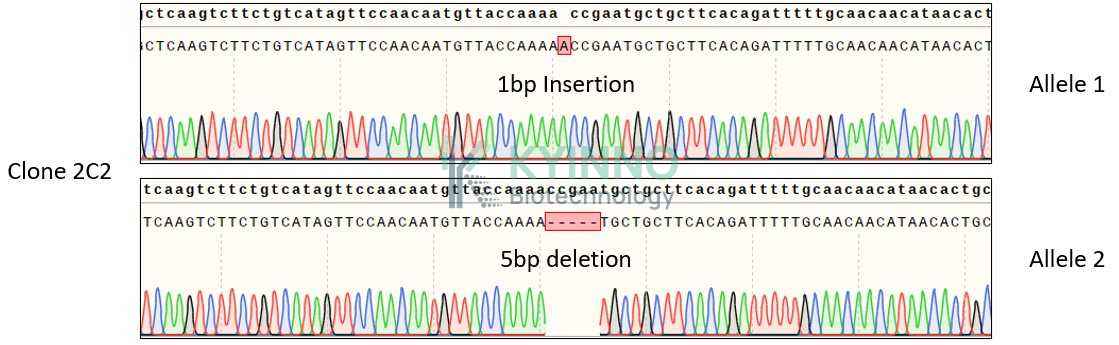
Stable 293T clone with ACVR1C gene knockout, No.2C2
Quantity:
Two vials of frozen cells (2-5×10⁶/vial)
Stability:
Stable in culture over a minimum of 10 passages
Application:
Drug screening and biological assays
Freezing Medium:
70% DMEM+20% FBS+10% DMSO
Propagation Medium:
DMEM+10% FBS
Selection Marker:
NA
Morphology:
Epithelial
Subculture:
Split saturated culture 1:4-1:8 every 2-3 days; seed out at about 1-3 × 10⁵ cells/mL
Incubation:
37 °C with 5% CO2
Storage:
Liquid nitrogen immediately upon receiving
Doubling Time:
Approximately 30 hours
Mycoplasma Status:
Negative
In Vivo Validation:

Cell Line Generation

293T-ACVR1C-KO cell line was generated using the CRISPR method.

Characterization

Figure 1: Characterization of ACVR1C knockout in 293T using PCR sequencing.

Figure 2: Characterization of ACVR1C knockout in 293T using RT-PCR sequencing.

Cell Resuscitation

  1. Prewarm culture medium (DMEM + 10% FBS) in a 37°C water bath.
  2. Thaw the frozen vial in a 37°C water bath for 1-2 minutes.
  3. Transfer the vial into biosafety cabinet, and wipe the surface with 70% ethanol.
  4. Unscrew the top of the vial and transfer the cell suspension gently into a sterile centrifuge tube containing 9.0mL complete culture medium.
  5. Spin at ~ 125 × g for 5-7 minutes at room temperature, and discard the supernatant without disturbing the pellet.
  6. Resuspend cell pellet with the appropriate volume of complete medium and transfer the cell suspension into a T25 culture flask.
  7. Incubate the flask at 37°C, 5% CO2 incubator.
  8. Split saturated culture 1:4-1:8 every 2-3 days; seed out at about 1-3 × 10⁵ cells/mL.

Cell Freezing

  1. Prepare the freezing medium (70% DMEM + 20% FBS + 10% DMSO) fresh immediately before use.
  2. Keep the freezing medium on ice and label cryovials.
  3. Transfer cells to a sterile, conical centrifuge tube, and count the cells.
  4. Centrifuge the cells at 250×g for 5 minutes at room temperature and carefully aspirate off the medium.
  5. Resuspend the cells at a density of at least 3×10⁶ cells/mL in chilled freezing medium.
  6. Aliquot 1 mL of the cell suspension into each cryovial.
  7. Freeze cells in the CoolCell freezing container overnight in a -80°C freezer.
  8. Transfer vials to liquid nitrogen for long-term storage.

References

  1. Ibáñez CF. Regulation of metabolic homeostasis by the TGF-β superfamily receptor ALK7. FEBS J. 2022 Oct;289(19):5776-5797. doi: 10.1111/febs.16090. Epub 2021 Jul 11. PMID: 34173336.
  2. Lin SY, Huang H, Yu JJ, Su F, Jiang T, Zhang SY, Lv L, Long T, Pan HW, Qi JQ, Zhou Q, Tang WF, Ding GW, Wang LM, Tan LJ, Yin J. Activin A receptor type 1C single nucleotide polymorphisms associated with esophageal squamous cell carcinoma risk in Chinese population. World J Gastrointest Oncol. 2025 Jan 15;17(1):96702. doi: 10.4251/wjgo.v17.i1.96702. PMID: 39817119; PMCID: PMC11664604.
  3. Hong X, Wen B, Zhang H, Li Y, Wu H, Zhao W, Luo X. Biological effects of NODAL on endometrial cancer cells and its underlying mechanisms. Exp Ther Med. 2021 Apr;21(4):402. doi: 10.3892/etm.2021.9833. Epub 2021 Feb 25. PMID: 33717261; PMCID: PMC7938447.
  4. https://www.ncbi.nlm.nih.gov/gene/130399