Notice: 函数 WP_Styles::add 的调用方法不正确。 The style with the handle "storefront-woocommerce-style" was enqueued with dependencies that are not registered: storefront-style. 请查阅调试 WordPress来获取更多信息。 (这个消息是在 6.9.1 版本添加的。) in /wordpress/wp-includes/functions.php on line 6260

KB-1645

Brivekimig

Home » Brivekimig

Background of Brivekimig

OX40L(CD252) is mainly expressed on antigen presenting cells (APCs), and the expression of OX40L can be detected by APC within 1-3 days after contact with antigen.OX40L and OX40(CD134) can significantly enhance the activation process of T cells, which can amplify the cascade reaction of T cells and promote T cells from resting state to activated state. In addition, the combination of OX40L and OX40 can promote the proliferation of T cells, and the combination of OX40L and OX40 activates downstream signal pathways such as NF-κB, PI3K and AKT for clonal expansion, thus prolonging the life of T cells. OX40L can also enhance the production of cytokines, enhance the immune response of effector tumor-specific T cells and enhance the production of tumor-specific memory T cells by maintaining the expression of anti-apoptosis proteins such as BCL-XL, BCL-2 and survivn. Tumor necrosis factor α (TNF α), also known as cachectin and TNFSF1A, is an effective pro-inflammatory cytokine, which is mainly secreted by macrophages. There are two biologically active forms of TNF-α: transmembrane form (tmTNF-α) and secretory form (sTNF-α). TNFalpha binds to its receptors, mainly TNFR1 and TNFR2, and then transmits signals to realize the function of regulating immune cells. As an endogenous pyrogen, it can promote fever, cause cell apoptosis, cause sepsis (by inducing the production of IL-1 and IL-6), cause cachexia, cause inflammation, and prevent tumor occurrence and virus replication.

Specifications

Catalog Number:
KB-1645
Antibody Name:
Brivekimig
Isotype:
VH-VH-VH-VH-VH
FC Muations:
N/A
Target:
OX40LxTNFa
Species Reactivity:
Human
Host Cell Line:
EXPI CHO
Purification Method:
Affinity purified
Concentration:
>2 mg/mL
Formulation:
50 mM sodium citrate,150mM NaCl,pH5.5
Purity:
>95% by SDS-PAGE and SEC-HPLC
Validation:
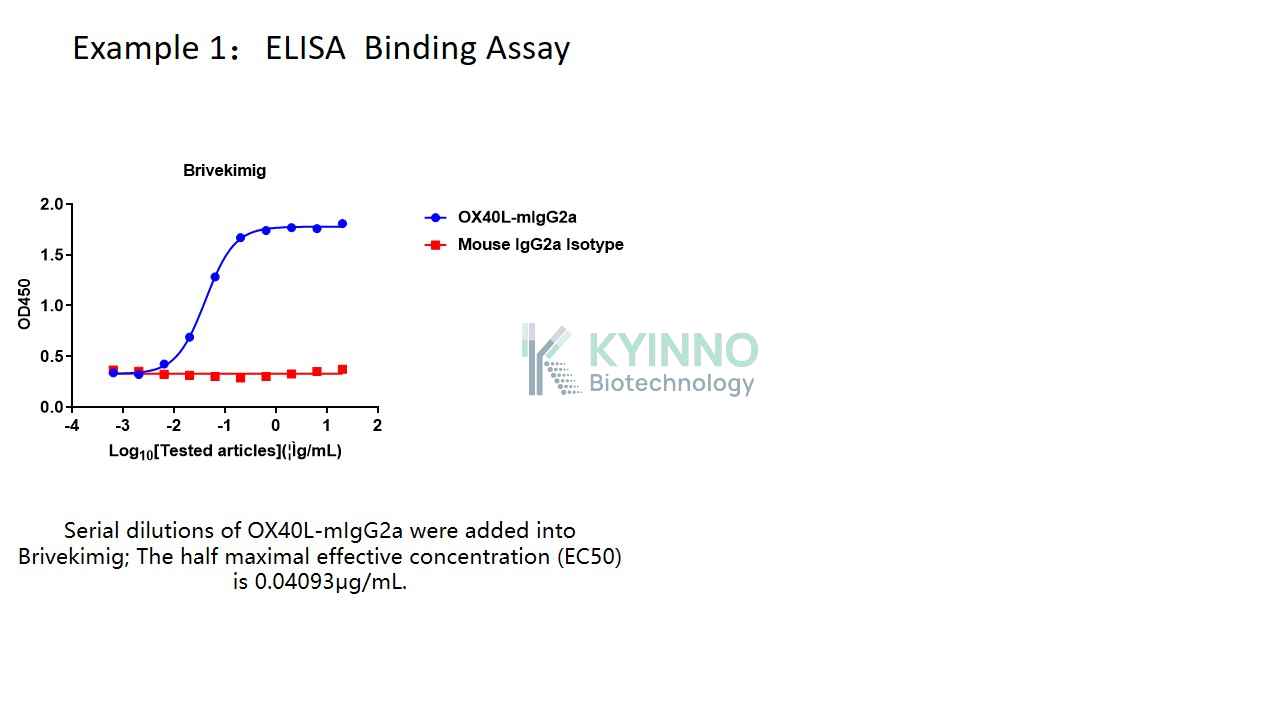
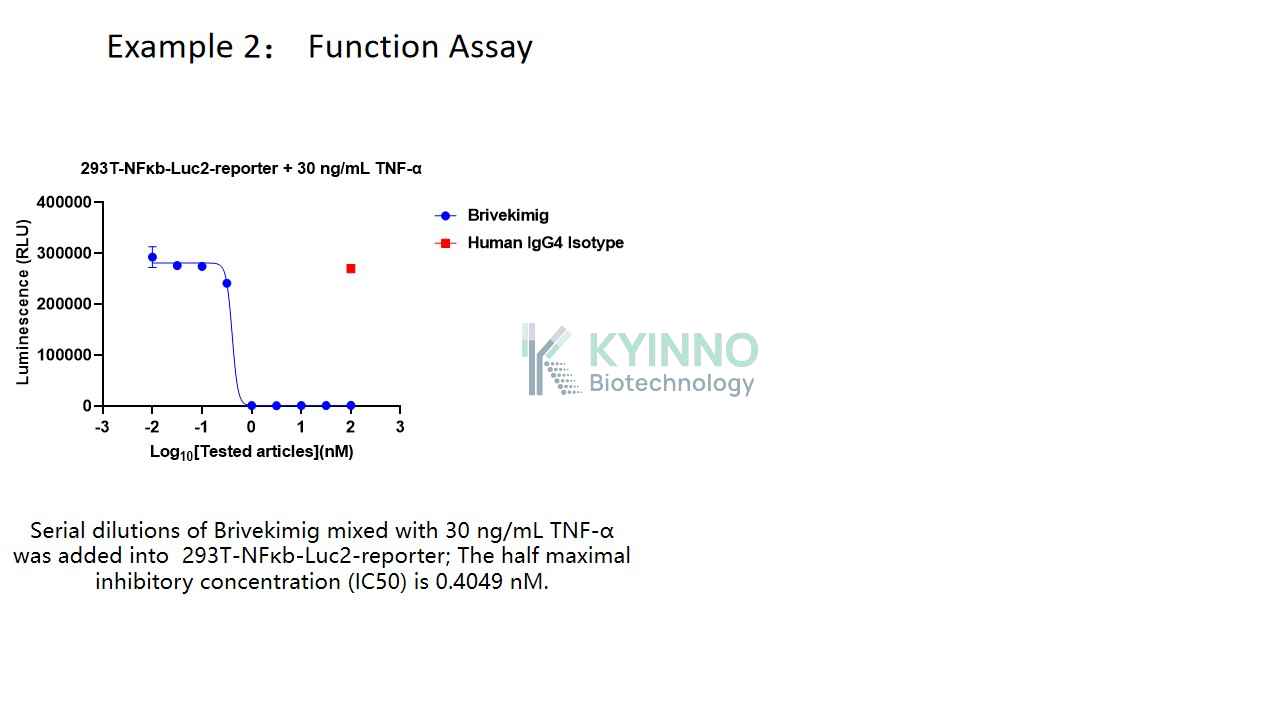
ELISA | Function Assay
Endotoxin Level:
<0.2 EU/mg as determined by the LAL method
Sterility:
0.2μm filtered
Storage:
It is recommended that the protein should be aliquoted for optimal storage. Avoid repeated freeze-thaw cycles.
Stability:
Stable for twelve months from date of receipt when stored at -20°C to -80°C; Stored at 2-8°C for one month without detectable loss of activity.

Characterization

Application

References

  1. Webb GJ, Hirschfield GM, Lane PJ. OX40, OX40L and autoimmunity: a comprehensive review. Clin Rev Allergy Immunol. 2016 Jun;50(3):312-32.
  2. Croft M, So T, Duan W, et al. The significance of OX40 and OX40L to T-cell biology and immune disease. Immunol Rev. 2009 May;229(1):173-91.
  3. Raval G, Mehta P. TNF-α inhibitors: are they carcinogenic?. Drug Healthc Patient Saf. 2010;2:241-247.
  4. Croft M. The role of TNF superfamily members in T-cell function and diseases. Nat Rev Immunol. 2009;9(4):271-285.